IGP simulation
OSPF simulation
OSPF (Open Shortest Path First) routing is the most widely used IGP protocol. It is a link-state protocol, where routers exchange so-called Link State Advertisement (LSA) messages, to propagate reachability information.
In OSPF, IP interfaces are associated with a positive integer metric, associated with the cost of transmitting information through it. This information is included in the LSAs that are exchanged among the AS nodes. By processing the LSAs received, each node is able to internally re-construct the topology of internal IP links in the AS, and compute the shortest path to them.
In OSPF, nodes can be arranged in areas. Each IP interface should be assigned to one and only one area and IP links can only occur between interfaces of the same area. A router with an interface to an area is assumed to belong to that area.
When multiple areas are defined:
- Each area only knows in its database the topology of IP links of its own area. This is because some types of LSAs (LSA types 1 and 2) are exchanged only within the nodes in the same area.
Note
Note that this reduces the signaling overhead and the router CPU consumption for computing the paths.
- In OSPF, area 0 is the so-called backbone area. Non-backbone areas must have at least one node that also belongs to the backbone area. Routers belonging to the backbone area, and also to one or more other areas are called ABRs (Area Border Routers)
- ABRs distribute reachability information between areas, using so-called LSA summary messages. These messages contain a list of IGP destinations, together with the cost to reach them, counting from the ABR to the destination. To avoid the creation of loops when forwarding inter-area traffic, an ABR (i) injects in the backbone the information of the destinations of the non-backbone areas it is connected to, while (ii) injects in the non-backbone areas, all the destinations except those inside the receiving area.
ENP OSPF simulation results in that:
- Intra-area routes to an IGP destination (or BGP next-hop) are always preferred over inter-area ones. These routes follow the shortest path between the nodes, considering only the area IP links.
- The inter-area route between two non-backbone areas must pass through the backbone area. The first area forwards the traffic to the ABR in its area which announces the lowest metric to the destination. The same policy is applied in the backbone area towards the end area.
- The inter-area route between a non-backbone area and the backbone forwards the traffic to the ABR in the origin area which announces the lowest metric to the destination. The same policy is applied in the backbone area towards the end area.
Assigning base areas to IP routers
As explained above, OSPF assigns areas to IP interfaces. However, ENP design tools need to decide which will be the assigned area to the new interfaces created by ENP.
To accommodate this requirement, ENP asks the user to assign a per-node IGP area number (0, 1, 2, ...). Area 0 is identified as the backbone area. Then:
- Interfaces with IP links between nodes in the same area are assigned to the area of the two nodes.
- Interfaces of IP links between nodes in different areas are assigned to the area of the lowest number. This means, e.g., that if one of the end nodes belongs to the backbone (area 0), both end interfaces are assigned to the backbone.
IS-IS simulation
IS-IS (Intermediate-System to Intermediate-System) is a routing protocol of link-state type, with many similarities with OSPF. Nodes in an IS-IS domain can belong to Level 1, Level 2, or both Level 1 and 2 areas. Level 2 nodes correspond (with some differences) to backbone routers in OSPF.
IS-IS domains with only Level 2 nodes defined are identical to single-area OSPF networks. This version of ENP cannot simulate multi-level IS-IS networks, although the majority of its behavior is similar to that of multi-area OSPF networks.
Equal-Cost Multi-Path
OSPF and IS-IS nodes, compute the shortest path to each destination (or the advertising ABR) over the IP topology reconstructed from the LSAs. If more than one shortest path exists with the same minimum cost, the Equal-Cost Multi-Path (ECMP) rule is applied.
ECMP rule means that the traffic is uniformly spread among all the different output links which have at least one shortest path route to the destination.
Some router operative systems set a limit to the maximum number of ECMP parallel output links over which the traffic can be spread (e.g. 8 or 16).
ENP permits setting this information individually for each IP node. By default, there is no limit to this number. When a limit K is set, the first K interfaces are selected in a list that orders the output interfaces by their IP address (lower first).
IGP metric optimization
ENP shows the IGP metric information for the IP links, in the IP links table.
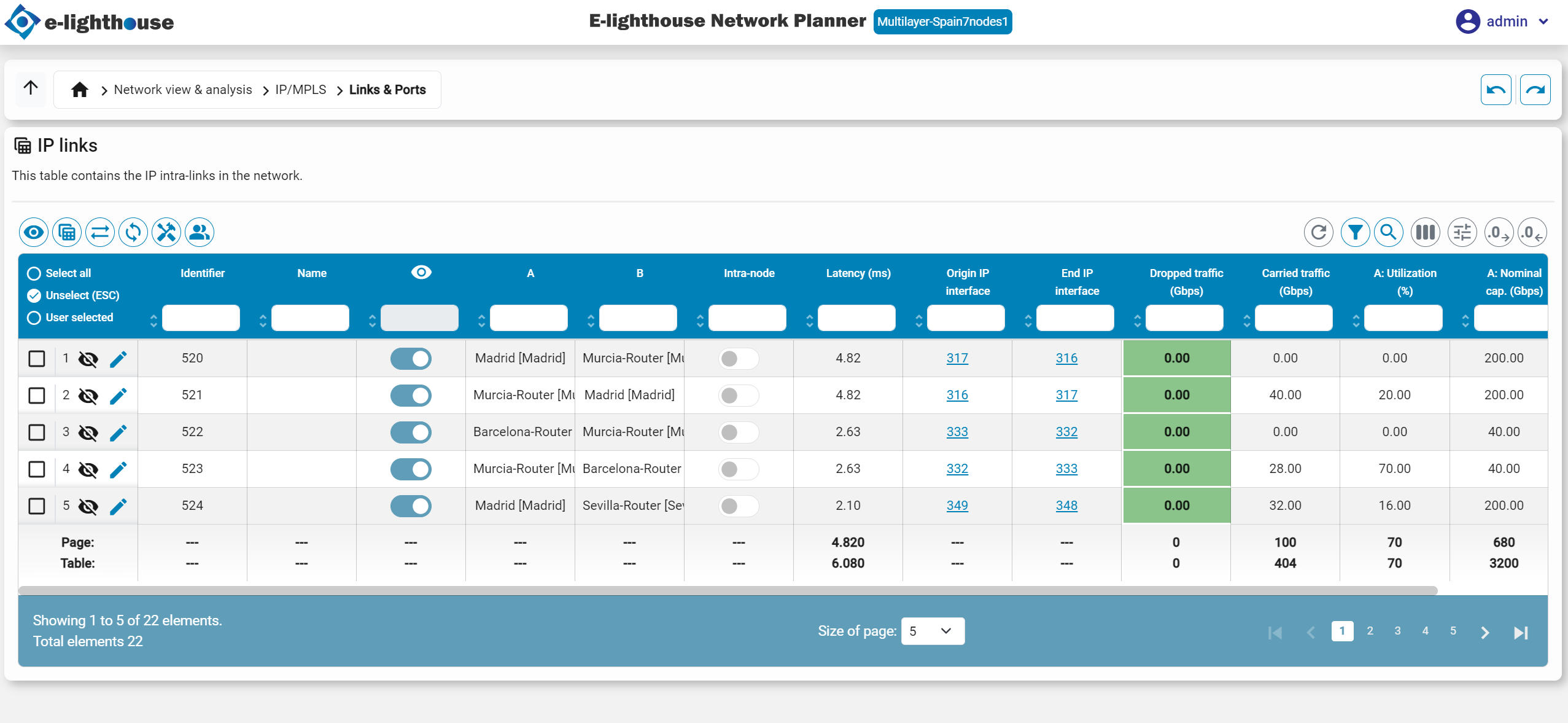
The system permits also the user to edit the IGP metrics, and then immediately observe the effect in the network of such changes. This can be done by:
- Manually setting a new IGP metric value in the appropriate cell of the IP link table.
- Setting in different forms the IGP metric to selected IP links in the table, via several right-click menu options in the table (e.g. setting a fixed IGP weight, or an IGP weight inversely proportional to IP port rates).
In addition, ENP provides several tools to recommend optimized IGP metrics with different load-balancing targets.
Definition of multiple IGP instances
ENP permits defining more than one IGP instance in the same Autonomous System. When an AS has more than one IGP instance defined:
- The user can specify for each IP demand, each IP multicast flow, and each multi-AS or MPLS-TE tunnel, which IGP instance to apply in each AS of the network, for routing the traffic through it.
- One of the IGP instances acts as a default IGP instance: the one to apply if no other IGP is specified.