E-Lighthouse Network Planner features
E-Lighthouse Network Planner (also known as ENP) offers a comprehensive range of functionalities for network design and simulation, including:
- Planning and simulation of IP/MPLS/SR networks including QoS configurations and traffic engineering for MPLS-TE and SR-TE.
- Planning and simulation of optical transport networks (OTN/DWDM) supporting multi-modulation and flexi-grid configurations.
- Multi-layer visualization of multivendor network topologies and elements analysis, enabling the joint visualization of IP, optical, and microwave networks, facilitating integrated analysis and optimization.
- Extensibility through plugins, adding specific functionalities such as smart provisioning, failure analysis, and optimized network dimensioning.
The ENP modular approach allows for the installation of features tailored to each customer’s needs, making it possible to add IP and transport features independently according to the network’s characteristics.
This high adaptability also facilitates fast and seamless integration with customer databases and platforms, enabling customized reporting solutions such as network expansion recommendations with integrated Bills of Materials (BOMs).
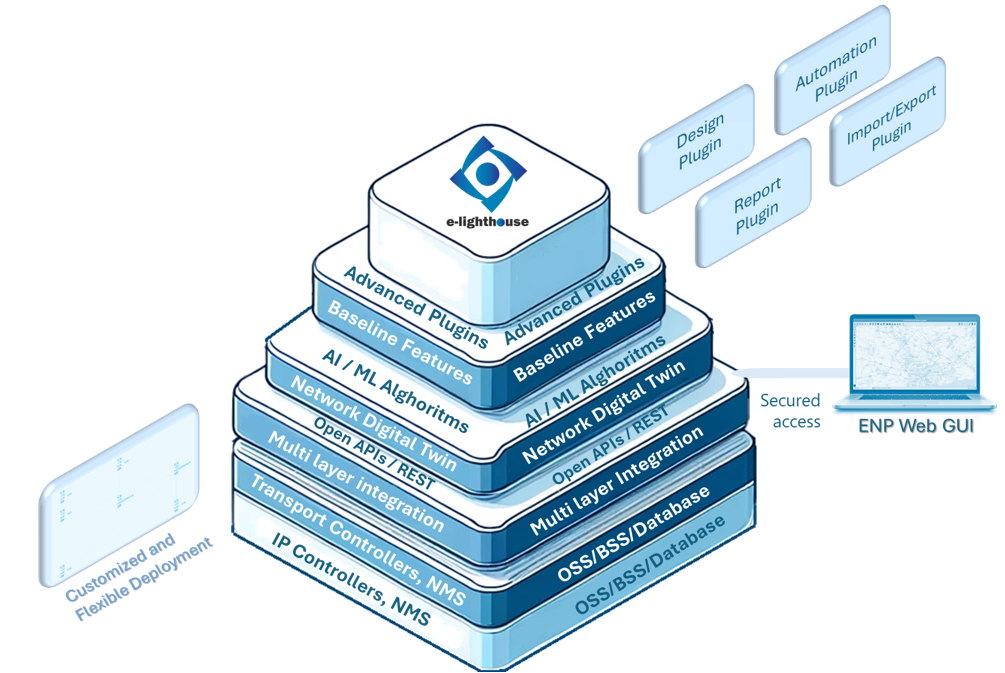
Summary of Features
ENP provides a wide set of features categorized across different network domains:
General Features
- Modular and extensible architecture
- Multi-vendor network support
- Seamless integration with existing customer databases and platforms
- Advanced reporting and network optimization tools
- Smart import and export functionalities for SDN, NMS, OSS, BSS, and Orchestrators
IP Network Features
- IP/MPLS Network Simulation: Multi-AS IGP/BGP, MPLS-TE, SR-TE, L2/L3VPN, IP multicast, QoS modeling, link aggregation
- L2-L3 VPN Simulation: Impact analysis and VPN-level KPIs
- IP Traffic Demand Forecasting: AI-based forecasting of traffic matrices and bottleneck prediction
- IP Network Risk Analysis: What-if failure analysis at service level
Transport Network Features
- OTN/DWDM Simulation: G.709 compliance, flex-grid, multi-modulation, multi-vendor support
- Smart Provisioning for OTN: Optical connection/service recommendations with KPIs and cost-benefit analysis
- Transport Network Risk Analysis: Service-level failure analysis and scenario comparison
Multilayer Features
- Multilayer IP & Transport Simulation: Impact analysis of changes across both layers
- Multilayer Fault Tolerance Analysis: SRG-based risk assessment across IP and transport networks
IP Network Capabilities
ENP offers several IP functions through its core system and plugins.
IP/MPLS Network Simulation
As a baseline, ENP offers multi-AS IGP/BGP simulation with:
- User-configurable traffic injection policies
- MPLS-TE tunnels and SR-TE path simulation
- User-defined QoS and link scheduling policies
- L2/L3VPNs, IP multicast, and link aggregation
These capabilities enable comprehensive network performance forecasting under various conditions.
L2-L3 VPN Simulation
This plugin allows:
- Analysis of VPNs at the IP layer
- Feature simulation for L3VPN and L2VPN
- KPI-based evaluation of VPN performance
- Extended failure analysis when used with the 'Fault Tolerance Analysis' plugin
IP Traffic Demand Forecasting
Using AI-powered predictive modeling, this plugin:
- Forecasts future traffic trends from historical monitoring data
- Generates IP traffic matrices for network capacity planning
- Simulates traffic demand for forecasting and scaling
- Creates synthetic traffic models when real data is unavailable
IP Network Risk Analysis
This plugin performs:
- Failure impact analysis at the service level
- Simulation of redundancy mechanisms at IP and transport layers
- Scenario-based risk assessment through What-if simulations
- Detailed risk reports for before/after comparisons
Transport Network Capabilities
For transport networks, ENP has an outstanding set of features available in its core and plugins.
OTN/DWDM Simulation
This module provides:
- G.709 compliance for standardized optical transport networks
- Flex-grid and multi-modulation support
- Multi-vendor network simulation
- State-of-the-art optical impairments modeling
- Routing and spectrum assignment (RSA) reports
Smart Provisioning for OTN
This feature enables:
- Optical connection (OTU) and service (ODU/DSR) provisioning
- Automatic recommendation of routes and assigned spectrum
- Service and route KPIs evaluation
- Cost-benefit analysis for provisioning decisions
- Faster service deployment with optimized resource utilization
Transport Network Risk Analysis
This plugin provides:
- End-to-end service failure impact assessments
- Support for multi-layer recovery mechanisms
- What-if failure analysis and visualization
- Service-level risk reports before and after simulations
Multilayer Capabilities
ENP provides multilayer capabilities through:
- Integration with multilayer controllers and orchestrators
- Direct extraction of IP and transport network topologies from network controllers or NMS
Multilayer IP & Transport Configuration and Simulation
This module allows:
- Holistic network analysis spanning IP & OTN layers
- Impact analysis of network changes on both layers
- Optimization of routing, adjacency settings, and recovery mechanisms
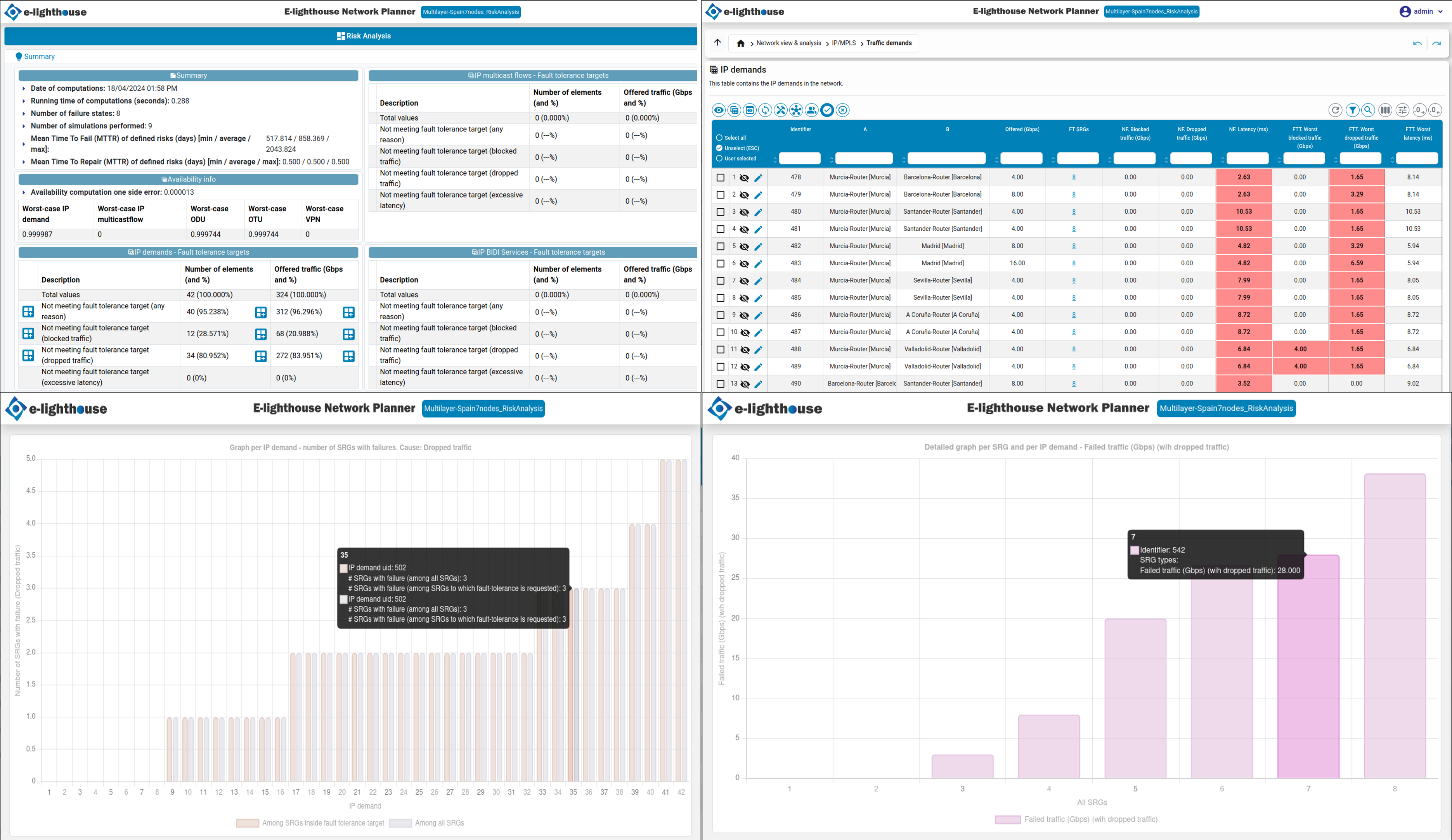
Multilayer Fault Tolerance Analysis
This plugin enables:
- End-to-end service risk evaluation across multiple layers
- Simulation of failures and recovery mechanisms across IP and transport layers
- SRG-based (Shared Risk Group) analysis
- Reports with failure impact and recovery scenarios
Smart Import & Export
Available for IP, transport, and multilayer networks, this module:
- Integrates with SDN, NMS, OSS, BSS, and Orchestrators
- Supports tailored import/export modules
- Automates network data processing from different sources
- Facilitates vendor-agnostic network integration
Ad-Hoc Features & Customization
One of ENP’s most powerful capabilities is its adaptability to unique client requirements.
By leveraging its modular and extensible architecture, ENP enables custom-built features designed to integrate seamlessly with customer-specific network environments, databases, and workflows.
Some examples of ad-hoc features developed for clients include:
- Bespoke optimization models for network expansion and cost reduction
- Custom network analysis tools aligned with enterprise-specific KPIs
- Integration with proprietary monitoring and performance platforms
- Automated configuration generation for network provisioning
- Tailor-made import/export mechanisms for legacy systems
- Custom visualization layers matching customer-specific topological layouts
Through this high level of customization, ENP ensures that each deployment aligns perfectly with the operational needs of the client, optimizing workflows while preserving full compatibility with their existing OSS, BSS, SDN controllers, and orchestration systems.
By prioritizing flexibility and extensibility, ENP empowers clients with a network planning solution that evolves alongside their infrastructure.